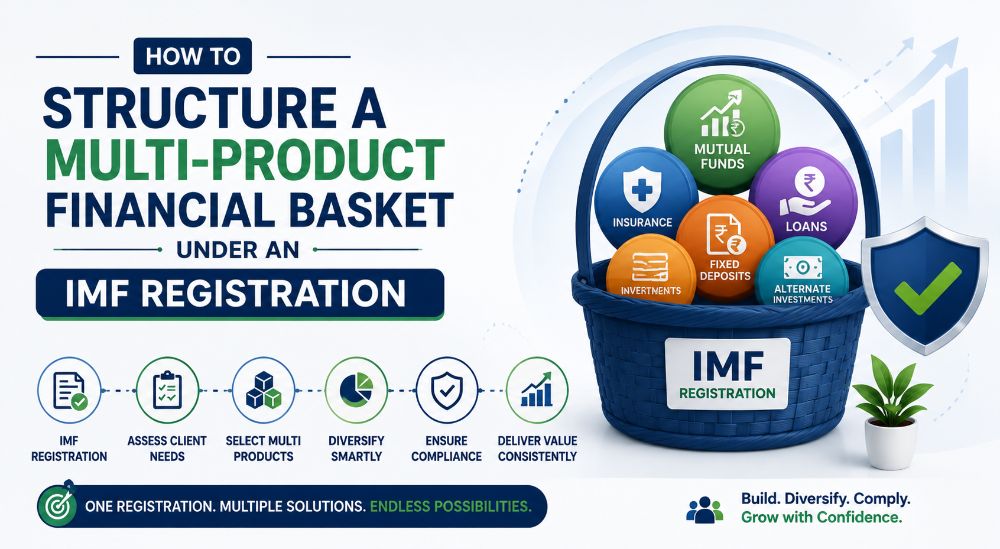
How to Structure a Multi-Product Financial Basket Under an IMF Registration
The financial services industry is rapidly evolving, and customers today prefer comprehensive solutions rather than dealing with multiple intermediaries for different financial needs. Whether it's insurance, mutual funds, pension products, or banking services, individuals increasingly seek a single point of contact that can help them make informed financial decisions.
This growing demand has made the Insurance Marketing Firm (IMF) model one of the most attractive business opportunities in India's financial distribution ecosystem. Introduced by the Insurance Regulatory and Development Authority of India (IRDAI), it allows firms to distribute multiple financial products through a single platform while maintaining regulatory compliance.
However, simply obtaining an IMF Registration is not enough. The real challenge lies in structuring a well-balanced multi-product financial basket that delivers value to customers while creating sustainable revenue streams for the business.
This guide explains how IMFs can effectively structure a diversified financial product portfolio to maximize customer satisfaction, regulatory compliance, and business growth.
Understanding the IMF Business Model
An Insurance Marketing Firm is a licensed entity authorized by IRDAI to distribute various financial and insurance products through trained personnel.
Unlike traditional insurance agents who primarily focus on insurance policies, an IMF can offer a broader range of financial products, enabling clients to access multiple solutions under one roof.
The objective is to create a customer-centric financial ecosystem where individuals can address different financial needs without approaching multiple service providers.
What Is a Multi-Product Financial Basket?
A multi-product financial basket refers to a carefully selected portfolio of financial products offered by an IMF.
Instead of focusing exclusively on insurance, the basket may include products from different categories, such as:
- Life insurance
- Health insurance
- General insurance
- Mutual funds
- Pension products
- Banking products
- Government-backed savings schemes
The goal is to provide holistic financial solutions tailored to different customer profiles.
Why Product Diversification Matters
Many financial distributors rely heavily on a single revenue source. While this may generate short-term income, it often limits growth opportunities and exposes the business to market fluctuations.
A diversified product basket offers several advantages:
Improved Customer Retention
When clients can access multiple financial products through a single advisor, they are less likely to switch service providers.
Multiple Revenue Streams
Different financial products generate commissions at different stages of the customer lifecycle. Diversification helps create a stable and recurring income model.
Better Financial Planning Solutions
Customers rarely have a single financial requirement. They may need insurance protection, retirement planning, wealth creation, and savings solutions simultaneously.
A broader product portfolio allows advisors to address these needs comprehensively.
Step 1: Build the Foundation with Insurance Products
Insurance remains the core offering under the IMF framework. Therefore, the financial basket should begin with a strong insurance portfolio.
Life Insurance
Life insurance products help customers secure their families against financial uncertainties.
Key offerings may include the following:
- Term insurance plans
- Endowment policies
- Child education plans
- Retirement-oriented insurance products
These products form the foundation of long-term financial security.
Health Insurance
The increasing cost of medical treatment has made health insurance a necessity rather than a luxury.
A strong health insurance portfolio may include the following:
- Individual health plans
- Family floater policies
- Senior citizen health insurance
- Critical illness coverage
Health insurance often serves as an entry point for building long-term client relationships.
General Insurance
General insurance products address day-to-day risks.
Common offerings include:
- Motor insurance
- Home insurance
- Travel insurance
- Commercial insurance
These products generate recurring renewal opportunities and strengthen customer engagement.
Step 2: Add Wealth Creation Products
Once protection needs are addressed, customers typically seek wealth-building opportunities.
This is where investment-oriented products become essential.
Mutual Funds
Mutual funds are among the most effective investment solutions for long-term wealth creation.
Different categories can cater to different risk appetites:
- Equity funds
- Debt funds
- Hybrid funds
- Index funds
- SIP-based investment plans
Offering mutual funds enables IMFs to support clients in achieving financial goals such as education, home ownership, and retirement planning.
Pension and Retirement Products
Retirement planning is becoming increasingly important as life expectancy rises and traditional pension systems become less prevalent.
Suitable options may include:
- National Pension System (NPS)
- Retirement-oriented mutual funds
- Pension insurance products
Including retirement solutions helps strengthen long-term client relationships.
Step 3: Incorporate Banking and Savings Solutions
Many customers prefer a single advisor who can assist with everyday financial requirements.
Banking-related products can complement insurance and investment offerings.
Potential solutions include:
- Fixed deposits
- Recurring deposits
- Savings-linked products
- Loan referral services
- Digital banking solutions
These products may not always generate high commissions, but they increase customer engagement and trust.
Step 4: Segment Products According to Customer Profiles
One of the biggest mistakes IMFs make is offering the same financial basket to every customer.
Different customer groups have different financial priorities.
Young Professionals
Primary needs often include:
- Term insurance
- Health insurance
- SIP investments
- Emergency fund planning
Families
Focus areas typically include:
- Family health coverage
- Child education planning
- Wealth accumulation
- Home protection
Business Owners
Suitable products may include:
- Keyman insurance
- Commercial insurance
- Tax-efficient investments
- Retirement planning
Senior Citizens
Recommended solutions often include:
- Health insurance
- Pension products
- Fixed-income investments
- Estate planning support
Customer segmentation ensures higher conversion rates and better service outcomes.
Step 5: Maintain Regulatory Compliance
While building a diversified financial basket, compliance must remain a top priority.
An IMF operates under IRDAI regulations and must ensure the following:
- Products are sold ethically.
- Customer suitability assessments are conducted.
- Documentation requirements are fulfilled.
- Mis-selling practices are avoided.
- Advisors remain adequately trained and certified.
Compliance-driven growth creates long-term credibility and reduces regulatory risks.
Step 6: Leverage Technology for Product Integration
Technology plays a crucial role in managing a multi-product financial basket efficiently.
Modern IMF businesses increasingly use the following:
- Customer Relationship Management (CRM) systems
- Financial planning software
- Policy management tools
- Digital onboarding platforms
- Automated renewal tracking systems
These tools help advisors provide a seamless customer experience while improving operational efficiency.
Common Mistakes to Avoid
Many newly registered IMFs struggle because they focus more on product quantity than product strategy.
Some common mistakes include:
- Offering too many products without specialization.
- Prioritizing commission over customer needs.
- Ignoring customer segmentation.
- Neglecting staff training.
- Failing to track compliance requirements.
A carefully curated product portfolio usually performs better than an excessively broad and poorly managed one.
Conclusion
A successful Insurance Marketing Firm is not defined by the number of products it offers but by how effectively those products solve customer problems. Structuring a multi-product financial basket under an IMF Registration requires a balanced approach that combines insurance protection, wealth creation, retirement planning, and banking solutions.
By starting with core insurance products, adding investment options, segmenting customers effectively, and maintaining strict compliance standards, IMFs can build a sustainable and customer-focused financial distribution business.
In an increasingly competitive financial services market, firms that provide integrated financial solutions rather than standalone products will be better positioned to earn customer trust, increase retention, and achieve long-term growth.