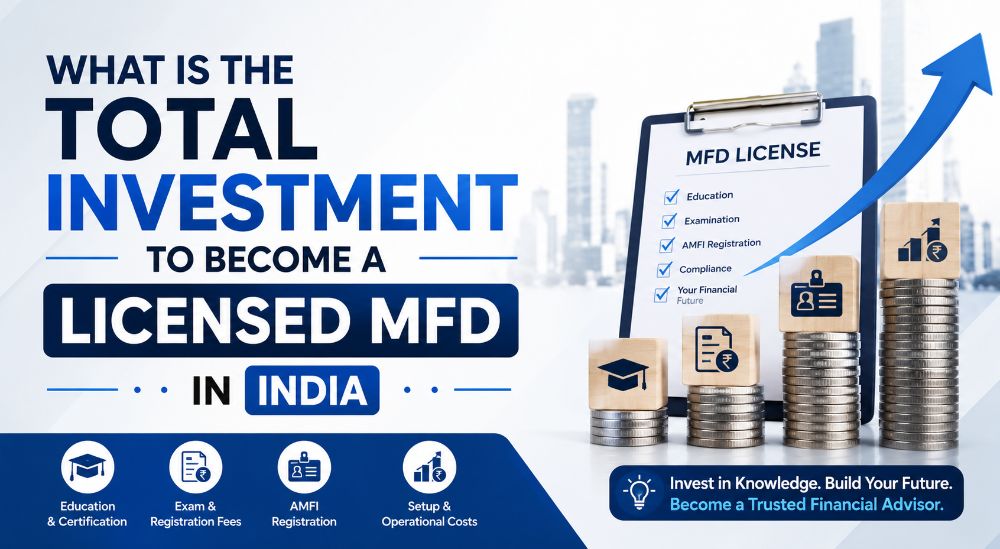
Which Is More Profitable: Mutual Fund Distributor License or Stock Broker License?
As you look to build a career in financial services in 2026, one of the most common dilemmas is choosing between a Mutual Fund Distributor (MFD) License and a Stock Broker License. Both offer high earning potential, but they operate on completely different business models, cost structures, and profitability timelines.
In 2026, the distinction has become even sharper due to new SEBI regulations and digital shifts. Here is a breakdown to help you decide which path is more profitable for your specific goals.
1. The Revenue Model: Trail vs. Transactional
The biggest difference lies in how you get paid.
Mutual Fund Distributor (MFD)
The MFD model is built on recurring income. You earn a "Trail Commission" (ranging from 0.1% to 1.5% annually) based on the total Assets Under Management (AUM) you hold.
- Profitability Secret: You get paid even if the client doesn't make a new investment this month, as long as their money stays in the fund.
- 2026 Shift: Under the April 2026 SEBI Master Circular, GST-registered MFDs receive a higher net payout compared to non-registered ones, making GST compliance a key factor in profitability.
Stock Broker
A broker’s income is primarily transaction-based. You earn "Brokerage" every time a client buys or sells a stock, future, or option.
- Profitability Secret: High-volume traders (Intraday and F&O) are your primary profit drivers.
- The Risk: If the market is flat or "boring" and clients don't trade, your income drops to zero.
2. Cost of Entry and Operations
Profitability is Revenue minus Expenses. This is where the MFD license often wins for beginners.
| Feature | Mutual Fund Distributor (MFD) | Stock Broker |
|---|---|---|
| Initial License Fee | ~₹1,500 (NISM) + ~₹1,500 (AMFI ARN) | ₹5 Cr to ₹50 Cr (Net Worth Requirement) |
| Infrastructure | Laptop & Phone (Can work from home) | High-end trading terminals, servers, and office |
| Compliance | Minimal (Annual returns/KYC) | Extreme (Daily reporting, audits, high SEBI fees) |
| Team Size | Can be a solo entrepreneur | Requires compliance officers and dealers |
3. Scalability and "The Snowball Effect"
When analyzing profitability, you must look at the long-term effort.
- MFD (The Snowball): It takes time to build your first ₹5 Crore AUM. However, once you reach a certain level, the "compounding" of the market grows your AUM (and your commission) even if you don't add new clients. In 2026, an AUM of ₹100 Crore can generate a stable, passive income of ₹60–80 Lakhs per year with very low overhead.
- Stock Broker (The Treadmill): To stay profitable, you must constantly keep your clients engaged. You are on a "treadmill" if you stop running (marketing/providing tips), the revenue stops. However, during a bull market, a stock broker can make more money in a single month than an MFD makes in a year.
4. Which One is "More Profitable"?
Choose an MFD License if:
You want high-margin, low-stress, recurring income. If you prefer building long-term relationships and want a business that eventually runs itself through passive trail commissions, the MFD route is significantly more profitable in terms of "Return on Effort."
Choose a Stock Broker License if:
You have large capital and a high-risk appetite. Being a main broker is a "Big Game." However, many individuals choose to become a Sub-Broker (Authorized Person) instead. This gives you the best of both worlds: you use the main broker’s infrastructure while earning a share of the brokerage, without the ₹5 Crore net-worth headache.
Summary for 2026
In the current 2026 market environment, for 90% of independent financial advisors, the Mutual Fund Distributor License is more profitable because of its near-zero operational cost and the predictability of trail income.
Stock brokering is highly profitable only for those who can operate at a massive scale or capture high-frequency derivative traders.