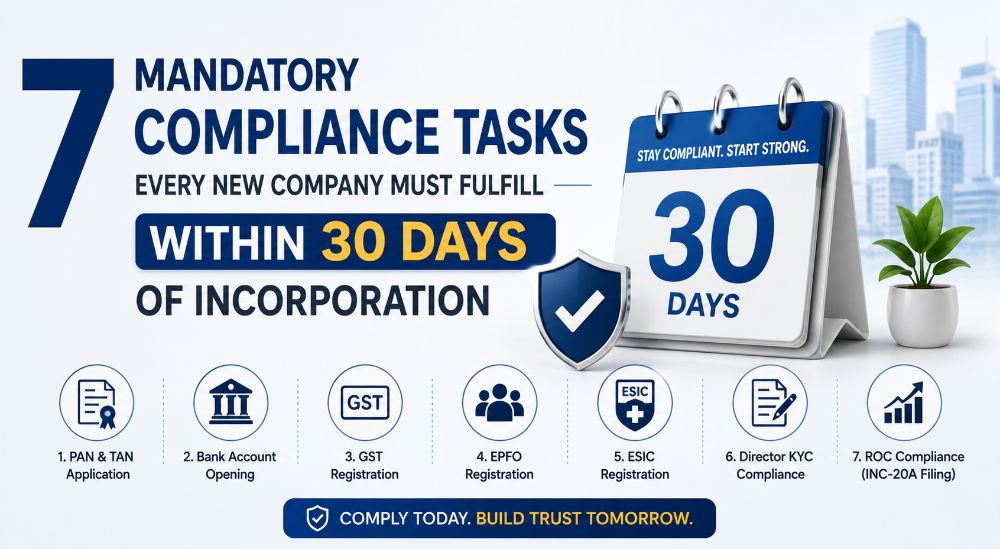
7 Mandatory Compliance Tasks Every New Company Must Fulfill Within 30 Days of Incorporation
Congratulations on incorporating your new company! Getting your Certificate of Incorporation (COI) from the Ministry of Corporate Affairs (MCA) is a massive milestone. However, the clock starts ticking the exact day your company is registered.
Under the Companies Act, 2013, a newly formed corporate entity must hit several legal milestones within the first month. Skipping these early steps triggers automatic electronic penalties from the Registrar of Companies (ROC), blocks your banking operations, and creates immediate compliance issues.
Use this foundational post-incorporation checklist to clear the 7 mandatory compliances required within your first 30 days.
The 30-Day Post-Incorporation Checklist
1. Open the Company's Current Bank Account
While the law doesn't explicitly state "30 days" for a bank account, you cannot execute your other 30-day legal mandates without it. This must be your very first step.
- Why it matters: Every single transaction from receiving share subscription money to paying initial setup bills must flow through a dedicated corporate account, not a personal one.
- What you need: The Certificate of Incorporation, Memorandum of Association (MOA), Articles of Association (AOA), the company's PAN/TAN, and a formal board resolution authorizing the account opening.
2. Name Board and Corporate Stationery Setup
Your company must establish its physical identity under Section 12(3) of the Act.
- The Rule: You must paint or affix the company's name and registered office address outside every office or place where business is carried on. It must be in a conspicuous position and written in legible letters.
- The Paperwork: Your Corporate Identification Number (CIN), registered office address, official email ID, and phone number must be printed on all business letters, billheads, invoices, and official publications.
3. Convene the First Board Meeting
Per Section 173(1), holding your first official Board Meeting within 30 days of incorporation is a strict legal requirement.
- The Timeline: A formal notice of the meeting must be sent to all directors at least 7 days in advance.
- The Agenda: This meeting acts as the formal launch of your corporate governance. The board will note the receipt of the COI, approve the bank account opening, adopt corporate stationery, and pass resolutions for critical structural appointments.
4. Appointment of the First Statutory Auditor
This is the most critical compliance step of your first month and is executed during the first board meeting.
- The Mandate: Under Section 139(6), the Board of Directors must appoint a practicing Chartered Accountant (CA) or a CA firm as the company’s first statutory auditor within 30 days from the registration date.
- The Safety Valve: If the board fails to appoint an auditor within this window, the responsibility shifts to the shareholders, who must appoint one within 90 days at an Extraordinary General Meeting (EGM).
5. Disclosure of Directors' Interests (Form MBP-1)
Transparency begins on day one. Every director must formally lay their financial cards on the table.
- The Requirement: Under Section 184(1), every director must disclose their concern or interest in any other companies, firms, or bodies corporate at the very first board meeting they attend.
- How it's done: Directors submit this disclosure using Form MBP-1. This document is filed into the company's permanent legal records to monitor and prevent unauthorized conflicts of interest.
6. Set Up and Maintain Statutory Registers
Your company is legally required to maintain formal internal records from its date of birth at its registered office.
- What to prepare: You must buy or digitally set up the Register of Members, Register of Directors & KMP (Key Managerial Personnel), Register of Share Allotments, and the formal minutes book for board and general meetings.
- The Impact: Keeping these blank or messy leaves you exposed to immediate penalties during an ROC inspection or investor due diligence.
7. State-Specific Local Registrations (Shop Act / Professional Tax)
Depending on the state where your registered office sits, local employment and commercial laws kick in immediately after incorporation.
- Shop & Establishment License: Most states mandate that you register your office under the local Shops Act within 30 days of starting work.
- Professional Tax (PT) Registration: If you plan to hire employees or start paying directors immediately, your entity must register for Professional Tax with the state government commercial tax department within 30 days.
Compliance Timelines at a Glance
The first few months require tracking distinct legal windows. Here is how your initial 30 days fit into the larger corporate setup timeline:
| Compliance Action | Regulatory Window | Primary Impact |
|---|---|---|
| First Board Meeting & Auditor Appointment | Within 30 Days | Establishes formal governance & accounting oversight |
| Issue Share Certificates to Subscribers | Within 60 Days | Legally delivers ownership to the founding members |
| Filing Form INC-20A (Commencement of Business) | Within 180 Days | Unlocks the legal right to actually start business operations |
Conclusion: Don't Risk Late Penalties on Day One
Completing your company incorporation is a major achievement, but it is only the first step of your business journey. The Ministry of Corporate Affairs (MCA) monitors these initial 30 days very closely through automated electronic systems. Missing a deadline like failing to appoint your statutory auditor or delaying your first board meeting can lead to immediate daily penalties and freeze your operations before they even begin.
By turning this post-incorporation checklist into an immediate action plan, you protect your startup from legal friction, build instant credibility with banks, and lay a rock-solid foundation for future growth. Welcome to the corporate world. Stay compliant, stay protected, and focus on scaling your business!