Understanding the Legal Framework of Company Registration in India
Starting a business is a journey from an idea to a legal reality. In India, this transition is governed by a robust legal framework that ensures transparency, trust, and growth. For any entrepreneur or startup owner, understanding the "how" and "why" of Company Registration in India is the first step toward building a credible brand.
This guide breaks down the legal landscape of Company Incorporation, the role of the Companies Act 2013, and the essential steps to get your business off the ground.
The Legal Foundation: Companies Act, 2013
Before 2013, India followed an older set of rules from 1956. The Companies Act, 2013 was introduced to modernize the business environment. It shifted the focus toward technology, faster processing, and better protection for small shareholders.
For a beginner, the Act serves three main purposes:
- Definition: It defines what a "Company" is a legal person separate from its owners.
- Regulation: It sets the rules for how a company should be managed daily.
- Protection: It provides "Limited Liability," ensuring that if the business fails, your personal assets like your home or savings remain protected.
Types of Business Structures
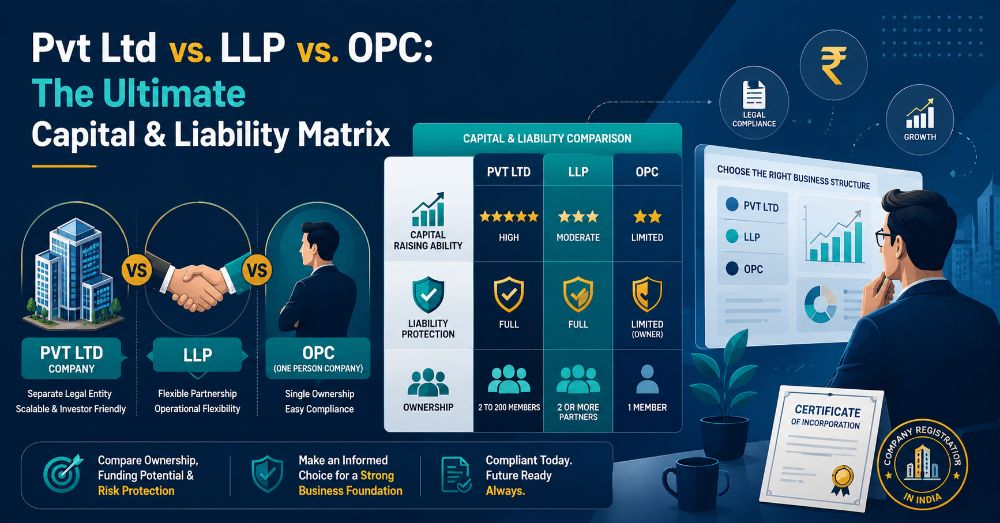
Choosing the right structure is the most critical decision in Company Formation. The legal framework offers various options based on the size and goals of your startup:
Private Limited Company (Pvt Ltd)
This is the "Gold Standard" for startups. It requires at least two directors and two shareholders. It is highly preferred by Venture Capitalists (VCs) because it allows for easy equity funding.
One Person Company (OPC)
Introduced specifically to encourage solo entrepreneurs, an OPC allows a single person to run a company with the benefits of limited liability. It’s a hybrid between a Sole Proprietorship and a Private Limited Company.
Limited Liability Partnership (LLP)
Regulated under a separate act (LLP Act, 2008), this is a mix of a partnership firm and a company. It is popular among service-based businesses because it has fewer compliance requirements than a Pvt Ltd company.
The Registration Process: From Name to Reality
The Ministry of Corporate Affairs (MCA) has simplified Company Registration through a digital-first approach. Here is the step-by-step legal roadmap:
Step 1: Digital Signatures (DSC)
Since all filings are electronic, the directors must obtain a Digital Signature Certificate. This acts as your legal identity in the virtual world, ensuring that the documents filed are authentic.
Step 2: Name Reservation (RUN)
Your company name is your identity. Legally, it must be unique and not infringe on any existing trademarks. You use the Reserve Unique Name (RUN) service to get approval from the Registrar of Companies (ROC).
Step 3: The SPICe+ Form
The Government of India introduced the SPICe+ (Simplified Proforma for Incorporating Company Electronically). This is a "super-form" that handles everything in one go:
- Application for Director Identification Number (DIN).
- Company Incorporation.
- PAN and TAN applications for taxes.
- Opening a bank account.
Essential Legal Documents
During Company Incorporation, you will come across two vital documents that act as the "DNA" of your business:
- Memorandum of Association (MoA): This document defines the company’s relationship with the outside world. It lists the "Objects Clause" what business the company is legally allowed to do.
- Articles of Association (AoA): This is the internal rulebook. It defines how directors are appointed, how meetings are conducted, and how shares are transferred.
Post-Registration Legal Compliance
Registration is just the beginning. To keep your company in good standing with the law, you must fulfill certain "Post-Incorporation" requirements:
- Appointment of First Auditor: Within 30 days of registration, the board must appoint a Chartered Accountant.
- Registered Office Verification: You must provide proof of the business address (like a rental agreement or utility bill).
- Issue of Share Certificates: The company must issue physical or electronic certificates to its shareholders within 60 days.
- Annual Filings: Every year, you must file financial statements (AOC-4) and annual returns (MGT-7) with the MCA. Failure to do this can lead to heavy penalties or the company being "struck off" (closed by the government).
Why Registering Your Company Matters
For a startup owner, Company Registration in India offers more than just legal compliance; it offers a competitive edge:
- Trust and Credibility: Customers and vendors prefer dealing with registered entities rather than unregistered ones.
- Fundraising: You cannot raise money from professional investors or take significant bank loans without being a registered company.
- Brand Value: Registration protects your brand name from being copied by others.
Conclusion
The legal framework for Company Formation in India has evolved to become one of the most entrepreneur-friendly systems in the world. While the jargon might seem complex, the underlying goal of the Companies Act, 2013 is to help you build a transparent and scalable business.
By following the right steps from choosing the correct structure to maintaining annual compliances you ensure that your startup isn't just a temporary project, but a long-term legal institution.