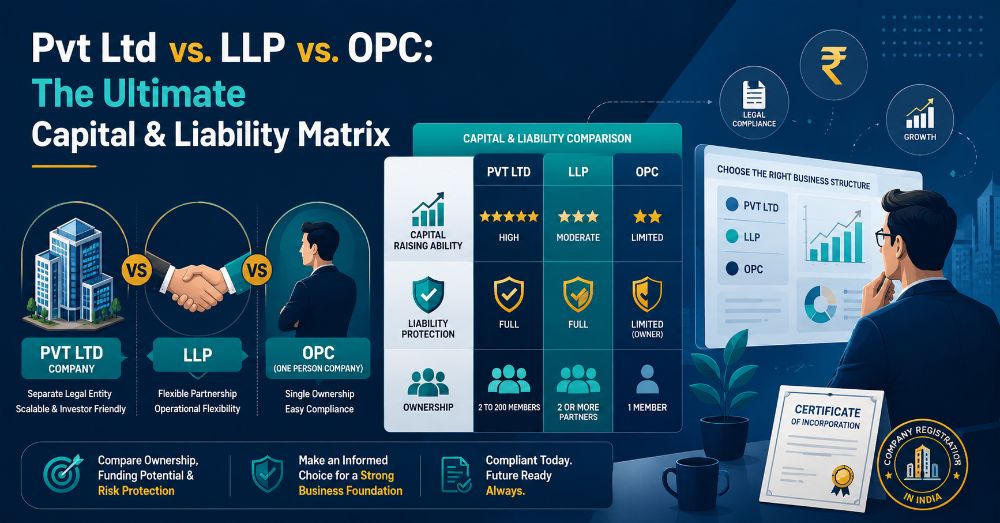
Pvt Ltd vs. LLP vs. OPC: The Ultimate Capital & Liability Matrix
Choosing the right business structure is one of the most important decisions an entrepreneur makes before starting a venture. Whether you are launching a startup, professional practice, or solo business, your choice can affect fundraising opportunities, legal compliance, taxation, and personal liability.
When considering Company Registration in India, three popular options stand out: Pvt Ltd Company, LLP, and OPC. Each structure offers unique advantages and limitations. Understanding their differences can help you select the entity that aligns with your business goals.
Understanding the Business Structures
Private Limited Company
A Private Limited Company is a separate legal entity governed by the Companies Act, 2013. It requires a minimum of two shareholders and two directors. This structure is widely preferred by startups and growing businesses because it allows equity funding and offers strong credibility in the market.
Limited Liability Partnership
An Limited Liability Partnership combines the flexibility of a traditional partnership with the benefit of limited liability. Governed by the LLP Act, 2008, it requires at least two partners and is commonly chosen by consultants, professionals, and service-based firms.
One Person Company
An One Person Company is designed for solo entrepreneurs who want the advantages of a corporate structure without adding partners. It allows a single individual to own and manage a company while enjoying limited liability protection.
Capital Matrix: Funding and Growth Potential
The ability to raise capital is a major factor when deciding on a business structure.
Pvt Ltd Company
A Private Limited Company offers the greatest flexibility for raising funds. It can issue shares to founders, investors, angel investors, and venture capital firms. Because ownership is represented through shares, investors generally prefer this structure.
For businesses planning aggressive growth and future investments, a Pvt Ltd Company is often the best choice.
LLP
An LLP cannot issue shares. Instead, partners contribute capital according to the LLP agreement. While additional capital can be introduced by existing or new partners, attracting institutional investors is often more difficult.
This makes LLPs suitable for businesses that do not depend heavily on external funding.
OPC
An OPC is owned by a single shareholder, which limits capital-raising opportunities. While loans and internal investments are possible, equity funding is challenging. As businesses grow, many OPCs eventually convert into Private Limited Companies to attract investors.
Liability Matrix: Protecting Personal Assets
Liability protection is another critical consideration during Company Incorporation.
1. Pvt Ltd Company
In a Private Limited Company, shareholders' liability is limited to the amount they have invested. Personal assets are generally protected from business debts and liabilities, making it a secure option for entrepreneurs.
2. LLP
An LLP also provides limited liability protection. Partners are not personally responsible for the debts or misconduct of other partners. Their financial risk is usually limited to their agreed contribution.
3. OPC
Like a Private Limited Company, an OPC is a separate legal entity. The owner's liability remains limited, ensuring personal assets are protected from business-related obligations.
Quick Comparison
| Factor | Pvt Ltd Company | LLP | OPC |
|---|---|---|---|
| Minimum Members | 2 | 2 Partners | 1 |
| Liability Protection | Limited | Limited | Limited |
| Separate Legal Entity | Yes | Yes | Yes |
| Equity Funding | Excellent | Limited | Limited |
| Compliance Level | Higher | Moderate | Moderate |
| Investor Preference | High | Moderate | Low |
| Scalability | Excellent | Good | Moderate |
Compliance Requirements
Compliance obligations vary across all three structures.
- A Pvt Ltd Company has the highest compliance requirements, including annual filings, statutory records, and regulatory reporting.
- An LLP enjoys comparatively simpler compliance procedures, making it attractive for small and medium-sized businesses.
- An OPC has fewer compliance requirements than a Private Limited Company but still follows company law regulations.
Which Structure Should You Choose?
Your decision should depend on your long-term business objectives.
- A Pvt Ltd Company is ideal if you plan to raise investment, expand rapidly, or build a scalable startup.
- An LLP works best for professionals, consultants, and service providers seeking flexibility and lower compliance costs.
- An OPC is suitable for solo entrepreneurs who want limited liability protection and a formal business structure without involving partners.
Conclusion
There is no one-size-fits-all solution when it comes to Company Registration. A Pvt Ltd Company offers superior fundraising potential and scalability, making it the preferred choice for startups. An LLP provides flexibility and lower compliance requirements, while an OPC gives solo entrepreneurs the benefits of a corporate entity.
Before proceeding with Company Registration in India, evaluate your funding needs, growth plans, and risk exposure. Choosing the right structure during Company Incorporation can create a strong foundation for your business and support its long-term success.