What is the Total Investment to Become a Licensed MFD in India?
The Indian mutual fund industry has witnessed an unprecedented surge, with Assets Under Management (AUM) crossing ₹82 lakh crore in early 2026. For professionals looking to enter this high-growth sector, the path of a Mutual Fund Distributor (MFD) is one of the most accessible and cost-effective entry points in the financial services world.
Unlike many other businesses that require significant upfront capital for inventory, storefronts, or specialized equipment, becoming an MFD is primarily an investment in your knowledge and regulatory compliance. If you are planning your financial career this year, here is a detailed breakdown of the total investment required to become a licensed MFD in India.
1. Education and Certification: The NISM Series V-A Exam
The very first step and the first financial commitment is obtaining the mandatory certification. In India, the Securities and Exchange Board of India (SEBI) mandates that anyone distributing mutual fund units must clear the NISM Series V-A: Mutual Fund Distributors Certification Examination.
The Registration Fee
As of May 2026, the standard registration fee for the NISM Series V-A exam is ₹1,500 plus GST. This fee covers one attempt at the 100-question computer-based exam. Since there is no negative marking, most candidates who prepare well clear it on their first try, but it is important to note that any re-attempts would require a fresh registration fee.
Study Material Costs
NISM provides a free digital workbook (PDF) upon successful registration for the exam. However, if you prefer physical books or third-party training materials, you might spend an additional ₹500 to ₹1,000. Many fintech distribution platforms also offer free mock tests and training modules to help candidates clear the exam, which can keep your preparation costs at nearly zero.
2. The AMFI Registration Number (ARN): Your Official License
Once you have your NISM certificate in hand, the most significant "investment" occurs during the application for your AMFI Registration Number (ARN). This is your official license issued by the Association of Mutual Funds in India (AMFI).
Individual Registration Fees
For individuals and sole proprietorships, the registration fee for a fresh ARN is ₹3,000 plus 18% GST, totaling approximately ₹3,540. This license is typically valid for three years, after which a renewal fee is applicable (currently around ₹1,500 plus GST).
Non-Individual (Corporate) Registration Fees
If you are looking to start a more formal business structure, the costs increase significantly based on the entity type:
- Proprietorship Firms: ₹3,000 + GST
- Partnership Firms and LLPs: ₹40,000 + GST
- Private Limited Companies: ₹40,000 + GST
- Public Limited Companies: ₹4,00,000 + GST
For most newcomers starting as individuals, the cost remains a manageable ₹3,540.
3. Know Your Distributor (KYD) and Biometrics
Before your ARN application can be processed, you must complete the Know Your Distributor (KYD) process. This is the distributor’s equivalent of a client’s KYC.
The KYD process involves verifying your identity and address through biometric data (fingerprint capture). This is usually handled by Computer Age Management Services (CAMS) or other designated points of service. While there is typically no separate "fee" for KYD itself, it is a mandatory prerequisite that must be completed alongside your ARN application. In 2026, many of these processes have moved online, but biometric verification often still requires a visit to a service center, so you may need to account for minor local travel expenses.
4. Operational and Infrastructure Costs
One of the greatest advantages of the MFD model is its flexibility. In the current digital-first era, your "office" can be your laptop.
Digital Infrastructure
To operate effectively, you will need a reliable computer and a high-speed internet connection. If you already own these, your incremental cost is zero. In terms of software, you do not necessarily need to build your own transaction portal. You can empanel with various AMCs directly or, more efficiently, join an MFD Distribution Platform. Many of these platforms offer their technology, transaction engines, and CRM tools for free or for a very nominal monthly subscription.
Marketing and Branding
While not mandatory for licensing, you should set aside a small budget for:
- Business Cards and Digital Presence: ₹1,000 - ₹3,000.
- Professional Networking: Fees for local business chapters or seminars.
5. Summary of Total Initial Investment (Individual Level)
If we sum up the mandatory costs for an individual professional in 2026, the numbers look remarkably affordable compared to other professional licenses:
- NISM Exam Fee: ₹1,770 (including GST)
- AMFI ARN Fee: ₹3,540 (including GST)
- Study Materials: ₹0 - ₹1,000
- Miscellaneous/Travel: ₹500
- Total: Approximately ₹5,810 to ₹6,810
Essentially, for less than ₹7,000, you can secure a professional license that allows you to tap into India’s multi-trillion rupee mutual fund industry.
Is there a "Zero Cost" Path?
In 2026, several large national distributors and fintech platforms have launched initiatives to lower the barrier to entry even further. Some platforms offer to reimburse your NISM and ARN fees once you join their platform and reach a very small initial milestone of Assets Under Management (AUM). If you choose this path, your net investment could effectively be zero, provided you are committed to building your business actively.
Final Thoughts: Investment vs. Return
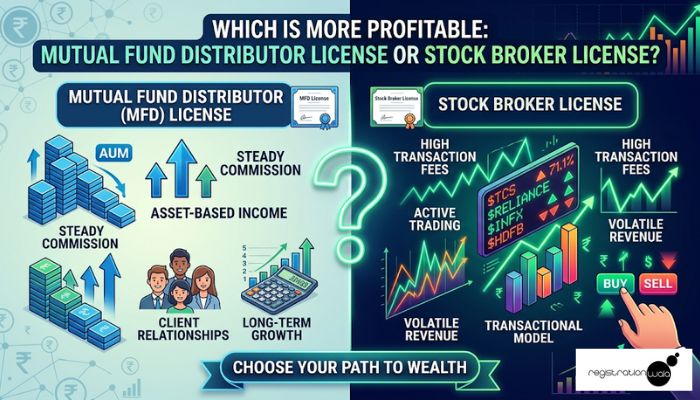
While the total investment to become a licensed MFD in India is under ₹7,000, the potential for "Return on Investment" is immense. Unlike a salary, an MFD’s income is based on Trail Commission. This means as your clients' wealth grows over time, your income grows with it without you needing to re-sell the product.
In a country where mutual fund penetration is still in its single digits relative to the population, the licensed MFD who invests this small amount today is securing a front-row seat to the future of Indian wealth management. The real investment isn't the money you pay to NISM or AMFI; it’s the time you spend educating yourself and building trust with your clients.
Would you like to know more about the specific documents required for the online ARN application process or how the trail commission structure works for new MFDs in 2026?